
Inside Stone County Tax Records
Appraisal facts and collection facts sit side by side in Stone County property tax records, and the Delta Computer Systems detail screen keeps them in separate blocks after naming the parcel and its situs. Read the field label first. A total value is not the assessed value. Neither one matches a sale price. A zero balance belongs only to the tax year shown on that account, so note the year before treating the parcel as current.
| Field | What It Shows | Where to Check |
|---|---|---|
| Land, improvements, total | The assessor's component and combined values | Delta appraisal or tax detail |
| Assessed value | The value to which millage is applied | Delta detail and assessment roll |
| Homestead and district | Displayed exemption code and taxing area | Parcel detail and Assessor |
| Due, paid, balance | Year-specific county, city, school, and other columns | Delta tax detail and Collector |
| Tax-sale history | Tax year, purchaser, and redemption display | Delta lead, then Collector and Chancery Clerk |
The official Stone County Tax Assessor and Collector divides the labor along the same line. The assessor finds, classifies, and values taxable property. Ownership maps stay with that office too. The collector receives real, personal, mobile-home, and vehicle taxes, and for what the value figures mean apart from the bill, see the focused Stone County property value explanation.
Stone County Tax Search Fields
The Delta tax search form accepts several routes. No field is marked required. There is no login and no search fee. A precise PPIN is usually the cleanest key, while rural parcels sometimes surface faster by section, township, and range when the address has changed or is missing.
| Search Label | Entry Format | Stone County Use |
|---|---|---|
| Name | Last name first; one field | Find accounts tied to an owner display |
| Address | Number and street in separate fields | Locate a known situs |
| Parcel Number | Up to 20 characters | Match the full county parcel format |
| Section/Township/Range | Separate short fields | Narrow rural land |
| PPIN | Up to six characters | Search both plain and zero-padded forms |
The county's official tax search form asks for only a few identifiers on one spare page. View the official Delta tax search screen.
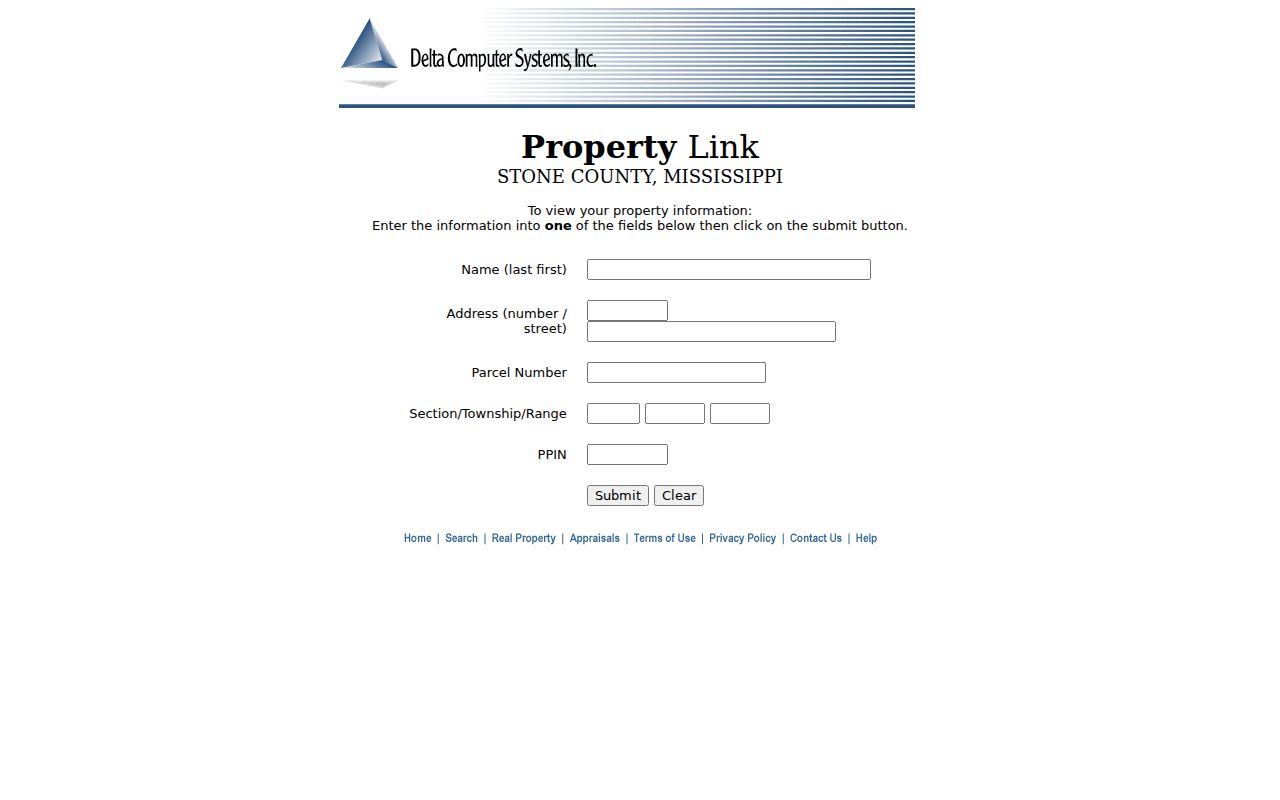
Match the search field to the identifier you already hold, whether that is a PPIN, a parcel number, or a street address. Then save the query and tax year too.
Read a Stone County Tax Bill
A Stone County account lookup should keep every layer of the record intact rather than shrinking it to one dollar figure. The tax table breaks the bill apart. County, city, school, and penalty amounts each sit on their own line, with due, paid, and balance columns beside them and a last-payment date at the end. A paid flag for one year proves little. Other years, liens, and recording issues stay open questions.
- Search the Delta tax system by PPIN, parcel, address, owner display, or section/township/range.
- Confirm the parcel number, situs, tax year, district, homestead code, and current update date.
- Read County, City, School, and Penalty & Other rows across due, paid, and balance columns.
- Save any tax-sale or redemption row, then request the underlying file from the Collector and recorded evidence from Chancery.
- Assessed value
- The portion of true value used in the tax formula after applying the state class ratio.
- Millage
- A tax rate applied to assessed value; it varies by year and district.
- Homestead exemption
- Relief that eligible owners must apply for within the county filing period.
- Tax lien
- A claim tied to unpaid tax that requires office and land-record confirmation.
Note: A print fee may apply on the vendor screen, so contact the county for the current total before ordering any copy.
A Stone County Tax Example
Dates and labels matter. A Stone County tax card for parcel number 005678 shows why. The 2025 row lists county tax of $1,024.72, penalty and other charges of $214.87, and a total due and paid of $1,239.59, with a zero balance and a last payment on August 31, 2026. The same card holds older tax-sale and redemption rows beneath the current figures. One dated account screen never speaks for every Stone County parcel.
The official sample tax card puts value and collection fields together in a single record.
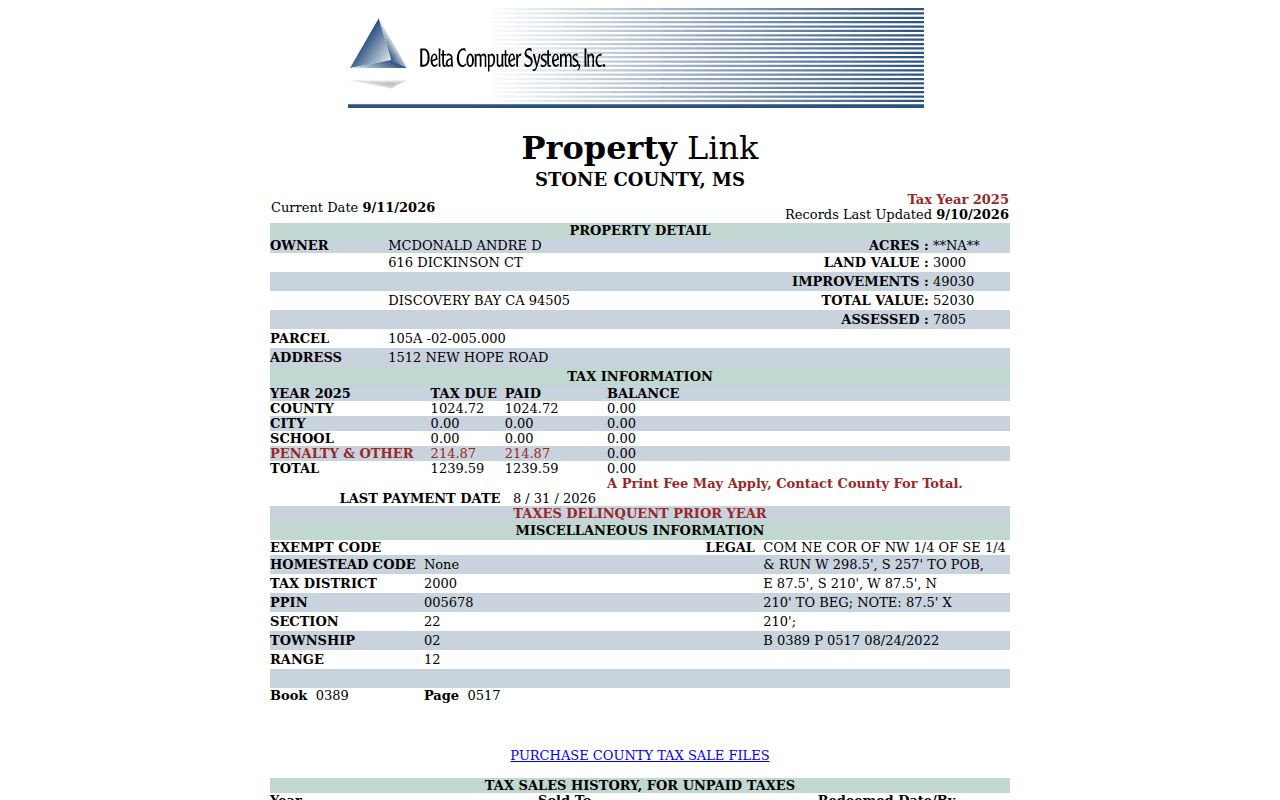
Labels deserve the same care. Calling “Penalty & Other” the base levy misstates the bill, and a tax-sale line still needs its own confirmation before anyone treats it as settled.
Stone County Tax Calendar
The county calendar gives every Stone County tax account its time context. Collection begins December 1. February 1 is the last day to pay without a late fee. It is also the first-half installment point. Pay the first half then, and the county allows real-property installments with one percent monthly interest on the later ones.
Land and personal-property rolls open for inspection July 15. July 31 is the last day to pay before the delinquent list runs in the newspaper. The first Monday in August closes valuation appeals. The property-tax sale lands on the last Monday in August. New millage begins October 1. Match every date to its year.
Each date on the calendar points to a different record in the file. Inspect the July roll before the appeal cutoff. A payment screen shows collection only. It will not show what evidence the Board reviewed, and publication merely gives notice while the sale and any later redemption create separate files. Save the parcel ID and PPIN with each item.
Note: Publication is not the tax sale, and a tax-sale purchaser line is not proof that title has transferred.
Stone County Homestead Records
Homestead filing opens on the first working day of January. It closes April 1. The Stone County assessor helps owners file applications for this property tax relief. Applicants bring a recorded deed, vehicle tag numbers, and purchase and construction facts. Mobile-home registration matters too. Age or full-disability claims need proof. The county also asks for sensitive personal identifiers. Those belong in the application rather than any public tax summary.
A Delta record can display a homestead code. A blank or “None” entry shows only an empty field. It proves nothing about why the parcel lacks the code. It cannot show whether an application was ever filed. Mississippi Department of Revenue material treats regular homestead relief as applying to the first $7,500 of assessed value. The maximum tax benefit is $300. Eligibility and timely filing govern the result. Confirm the current benefit with the assessor.
County instructions distinguish an ownership deed from a deed of trust. The recorded conveyance supports the ownership claim. A deed of trust is a security instrument, not proof of ownership. The county application collects Social Security numbers and birth dates for owners and certain household members. Those identifiers should never appear in a public summary or screenshot.
Stone County Rates Need Context
Mississippi builds its tax bills from a simple chain: true value, times the assessment ratio, times the millage rate. Class I owner-occupied single-family residential real property is generally assessed at 10 percent of true value. Class II, covering other real property, sits at 15 percent. Classification and exemption status shape the assessed figure before a single mill is ever applied.
The 2024–25 Department of Revenue table puts total Stone County millage at 142.42, split across county, school, road, junior college, fire, garbage, and other components. Treat that total as a snapshot, not an evergreen rate. Tax year and district can shift the bill. Never apply that dated total to a current parcel without confirming both.
The state table's visible components run from county general and ad valorem to road construction and maintenance, county school, junior colleges, fire, garbage, and an other category. Which of those rates reach an account depends on the parcel tax district. Penalty and other charges can then land apart from the levy itself. A fair comparison holds the tax year and district constant, and never mistakes the statewide class ratio for the parcel's full rate.
Ratio clue. A 10 or 15 percent relationship helps explain the record, but only the assessor can confirm a parcel's class and coding.
Stone County Tax Sale Entries
Unpaid real-estate taxes and special assessments can end up at the annual sale. The Delta history shows tax year, purchaser, redemption status, and redemption date. Rows can stretch across many years. A portal status can change at any time. It also cannot answer whether a tax deed, redemption, cancellation, or release was recorded. Save the dated row first. Ask the Collector for the sale and redemption file. Then ask the Stone County Chancery Clerk for any related land instrument. A Stone County Enterprise notice may add context. Neither a newspaper item nor a portal row is a certified title result.
Contest a Stone County Assessment
Stone County opens its rolls for public inspection on July 15. The first Monday in August is the deadline to appeal a valuation to the Board of Supervisors. The county publishes no dedicated online appeal form or decision archive. Contact the assessor or Board promptly. Ask how appeals must be delivered this year.
Good evidence starts with the parcel ID and the current appraisal card. Photographs help. Comparable Stone County cards with similar use and characteristics carry weight too. Keep the dispute focused on the assessment itself. The tax page owns payment and appeal mechanics. A deed ownership or boundary dispute belongs with a different record and office.
No county hearing archive exists online. Ask whether the Board wants originals, copies, or a set number of exhibits. Request a receipt showing when the appeal was delivered. Mark the disputed field for a wrong structure, land class, or parcel attribute. For a value dispute, explain why the comparable parcels match. Use, location, size, and valuation year should align.
Appeal window. The first Monday in August is the county's stated deadline; verify the current calendar and procedure before filing.